

Book an appointment

FREE LIVE ONLINE SESSION · FOR ADULTS WITH TYPE 2 DIABETES OR PREDIABETES

Fewer Diabetes Medicines. A Lower HbA1c. Under A Doctor's Supervision — Never On Your Own.

A free 75-minute live session with Dr Ajeet Pawar, M.D. (Ayurveda), on how type 2 diabetes remission actually works — who it works for, who it doesn't, and the exact lab markers we check before touching a single prescription.

  • 100% free
  • Recording sent to everyone who registers
  • No credit card
  • We never sell your health data
Portrait of the clinic's Ayurveda physician in a consultation room
Illustrative close-up of a printed medical report with an unreadable chart
  • SB Multi Speciality Ayurveda Hospital
THE DETAILS

Session logistics

Duration
75 minutes, including live Q&A
Platform
Zoom — link sent on WhatsApp and email
Language
Hindi & English
Price
Free
Recording
Yes — sent to everyone who registers, even if you can't attend live
Who it's for
Type 2 diabetes or prediabetes, any duration, including on insulin
Not for
Type 1 diabetes, and children under 18
LIVE ONLY

Live Q&A is for live attendees only.

The recording goes to everyone who registers. But the last 25 minutes — where I look at people's actual numbers and answer specific questions about their medicines — happens once, live, and isn't included in the recording.

WHAT YOU GET

What you'll walk away with

Your own remission-likelihood picture

The four markers that predict whether remission is realistic for you — and how to read three of them off the lab report you already have.

The medication question, answered properly

Which type 2 diabetes medicines can be tapered as your numbers improve, which ones must never be stopped abruptly, and who is allowed to make that decision. (It's your doctor. It is never you, and it is never a YouTube video.)

A food framework that survives an Indian kitchen

Rice, roti and family meals included, not banned. If a plan can't be eaten at your own dining table, it fails in week three.

What your current HbA1c is actually doing

The ten-year picture for your kidneys, eyes, nerves and heart at your current number, in plain language, without scare tactics — and how much of that changes at a lower one.

The real cost comparison

What lifetime medication, escalating doses, insulin and complication treatment cost over 10 and 20 years, against what a supervised remission program costs once. Most patients have never seen these two numbers side by side.

A clear yes or no on whether you're a candidate

Some people reading this can realistically reach remission. Some can't, and should focus on tight control instead. You'll leave knowing which group you're in.

THE METHOD

The 4-Marker Protocol

Why this is a medical process, not a diet.

  1. Candidacy

    Before anything changes, we check four things: your HbA1c, your fasting C-peptide, how many years you've had diabetes, and your waist-to-height ratio. These four together predict how much of your insulin-producing capacity is still there. If it's largely intact, remission is a realistic target. If it isn't, we say so and change the goal to tight control on fewer drugs.

  2. The Metabolic Reset

    A structured nutrition and movement phase built around your existing kitchen, your work schedule and your family's food. Weekly glucose logging, not monthly guesswork.

  3. Supervised Deprescribing

    This is the phase that makes supervision non-negotiable. As your glucose falls, the same dose of medication that was correct last month becomes too much this month. On sulfonylureas or insulin, that means a real risk of hypoglycaemia. So doses are reviewed every 1-2 weeks against your logged readings and adjusted downward by your doctor — in a planned sequence, in a specific order, never all at once.

    This is precisely what goes wrong when people attempt this alone.

  4. Maintenance and Re-testing

    Repeat labs at 3 and 6 months. Remission is defined by a sustained HbA1c below 6.5% off glucose-lowering medication — and it has to be re-earned, not assumed. You'll leave with a maintenance protocol and a re-test schedule.

Free · Recording included

Portrait of the clinic's Ayurveda physician
YOUR CLINICIAN

Dr Ajeet Pawar, M.D. (Ayurveda)

Panchakarma specialist and founder of SB Multi Speciality Ayurveda Hospital. BAMS from Govt. Ayurveda Medical College, Mysore (RGUHS, 2012) and M.D. (Ayurveda) from SDM Ayurveda Medical College, Udupi (2015).

  • SB Multi Speciality Ayurveda Hospital — Founder & Panchakarma Specialist, since 2015
  • BAMS, Govt. Ayurveda Medical College, Mysore · M.D. (Ayurveda), SDM Ayurveda Medical College, Udupi
  • Four branches across Karnataka — Mysore, Bengaluru, Devar Hipparagi and Pandavapura
  • Reg. No. 28853 · Karnataka Ayurveda and Unani Practitioners' Board

I'm not going to tell you diabetes is curable. I'm going to show you what remission means clinically, who achieves it, and what it takes.

PATIENT RESULTS

Real patients, real lab reports.

Diabetic foot and gangrene cases, before and after treatment.

These are unedited clinical photographs from our own case records at SB Multispeciality Ayurveda Hospital. Each image is hidden until you choose to view it.

Content warning: this section contains graphic wound photographs.

Diabetic foot ulcer, ankle — before and after treatment

Diabetic foot ulcer, sole — before and after treatment

Extensive lower-limb wound — before and after treatment

Diabetic wound, both hands — before and after treatment

Gangrene, forefoot and toes — before and after treatment

Diabetic foot ulcer, sole — before and after treatment

Gangrene, toes — before and after treatment

Individual results vary. These images are not a promise of any outcome. Source: our own case records, published at sbayurvedahospital.com.

Patient lab reports, before and after.

Independent biochemistry panels from outside diagnostic laboratories. All patient identifiers are permanently blacked out of the images.

The two cases below were tested at different independent laboratories.

Case 1

Before — 18 June 2025
After — 21 October 2025

HbA1c 11.0% (June 2025) to 5.7% (October 2025). Fasting blood sugar 342 to 138 mg/dl.

Case 2

Before — 19 September 2025
After — 12 December 2025

HbA1c 8.1% (September 2025) to 6.1% (December 2025). Fasting blood sugar 154 to 111 mg/dl. Triglycerides 925 to 265 mg/dl.

Individual results vary. These reports are not a promise of any outcome. Tap a report to view it full screen.

Published patient reviews from our hospital. These are for the conditions stated, not for diabetes remission.

I came here for a back pain, 2 weeks ago. The Doctor and the staff were very kind enough to provide the right therapies and the treatment was so good that, now I can very happily say that there is no pain. I seem to have fully recovered from the back ache I was suffering from. Thank you so much to the whole team for their support in this treatment.
Mr. S. PadmanabhamBack Pain
I visited SB Ayurveda Hospital with bad joint pains. I was not able to walk and sleep properly. Dr. Ajeet Pawar suggested virechana & podi kizhi along with the diet plans. I lost my weight and pains also reduced. The therapists are also very good. I almost recovered and am happy to say that I am very active in my day to day life now.
Miss. SwapnaJoint Pain
I have been experiencing a severe neck pain / shoulder pain. I visited Ortho/Physiotherapy for a month but I did not find any improvement. Then I visited SB Ayurveda Hospital and took treatment here. I found the improvement in a week. Then after complete course of 15 days, 90% of pain relieved. I am very happy to visit here.
Mr. DevaBack Pain & Neck Pain
Institution / affiliation logo 01 — placeholder mark
Institution / affiliation logo 02 — placeholder mark
Institution / affiliation logo 03 — placeholder mark
Institution / affiliation logo 04 — placeholder mark
PATIENT JOURNEYS

One patient at a time, stage by stage.

Each sequence below is a single patient's own photographs, taken over the course of treatment and shown in order from left to right. Read the stages under each image to follow what happened and when.

Content warning: these sections contain graphic wound photographs.

Case 01

Diabetic foot ulcer, sole and forefoot

A long-standing sole ulcer with thick dead tissue at the heel and a separate wound under the toes.
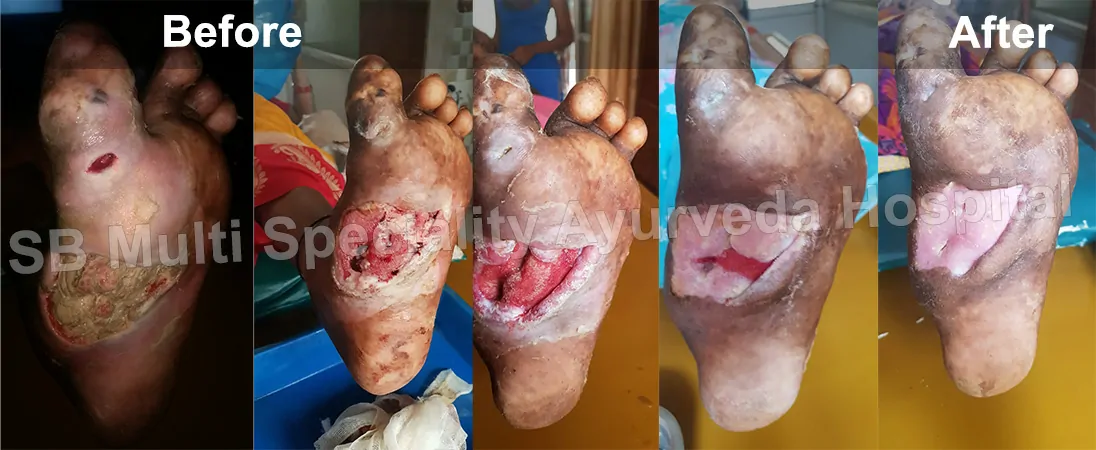
What happens at each stage

  1. Stage 1. On arrival: the sole carries a deep open ulcer with thick yellow slough, and the skin around it is hard and discoloured.
  2. Stage 2. Dead tissue is removed and the wound is cleaned, which opens up the true size of the ulcer.
  3. Stage 3. The base turns pink and moist as healthy tissue begins to fill the cavity from below.
  4. Stage 4. The opening narrows as the edges draw inward and the surrounding skin settles.
  5. Stage 5. A much smaller wound remains, with new skin covering most of the original area.

Note on this case

This foot arrived with tissue that was already dead and had to be removed before anything could heal — which is why the wound looks larger in the second frame than the first. That step is normal and expected. From there the work is daily wound care, Panchakarma procedures, and internal medicine adjusted to the patient's blood sugar readings at each review.

Individual results vary. This sequence is not a promise of any outcome, and it does not show every patient's experience.
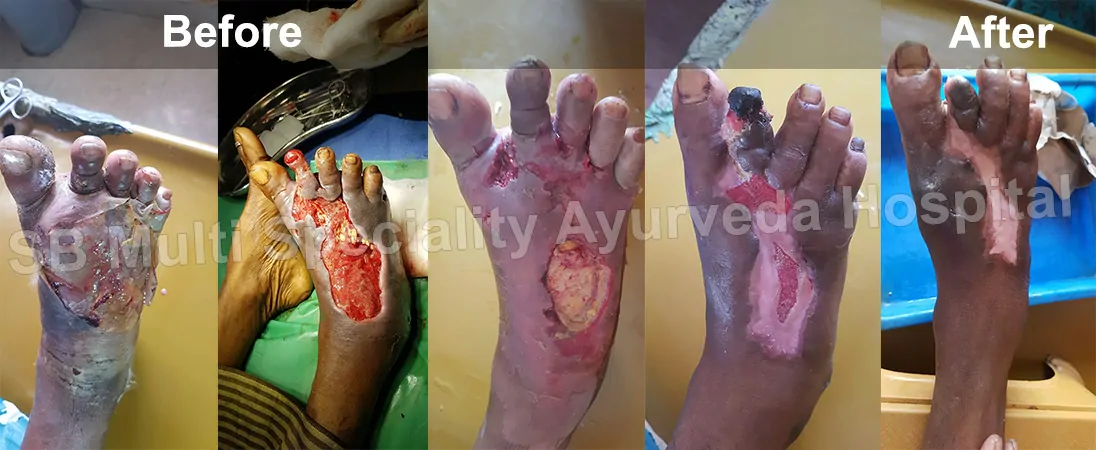
Case 02

Diabetic foot wound across the toes and top of the foot

An extensive wound involving the forefoot, the base of the toes and the top of the foot.

What happens at each stage

  1. Stage 1. On arrival: skin loss across the forefoot with darkened toes and exposed tissue underneath.
  2. Stage 2. The wound is cleaned in theatre and non-viable tissue is taken away.
  3. Stage 3. The bed becomes uniformly red and granular — the sign that blood supply is reaching the area.
  4. Stage 4. One dark area at the toe base is dealt with separately while the rest of the foot continues to close.
  5. Stage 5. The foot is intact, with new skin over the healed area and the toes preserved.

Note on this case

The goal in a foot like this is to keep the foot. Toes that are still receiving blood are protected rather than removed, and the darkened areas are treated one at a time as the surrounding tissue recovers. Progress is checked at every dressing change.

Individual results vary. This sequence is not a promise of any outcome, and it does not show every patient's experience.
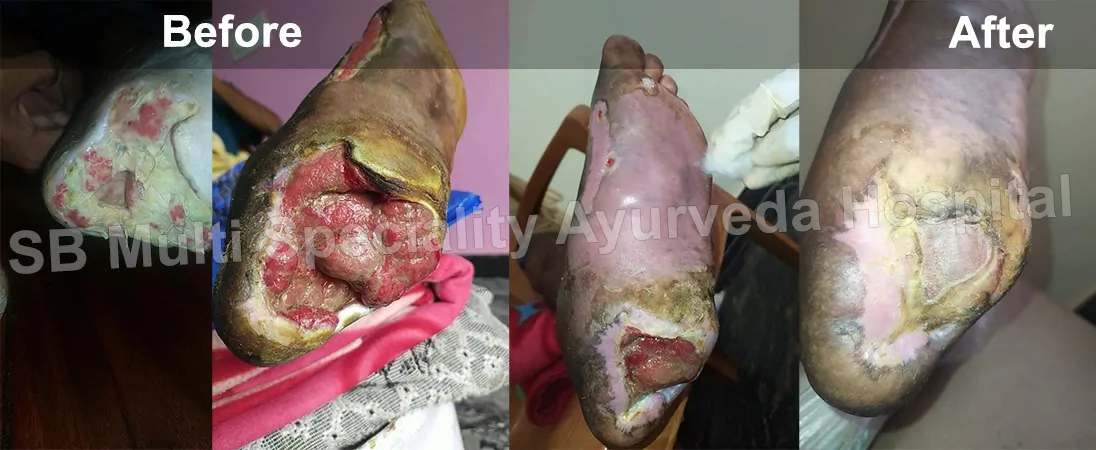
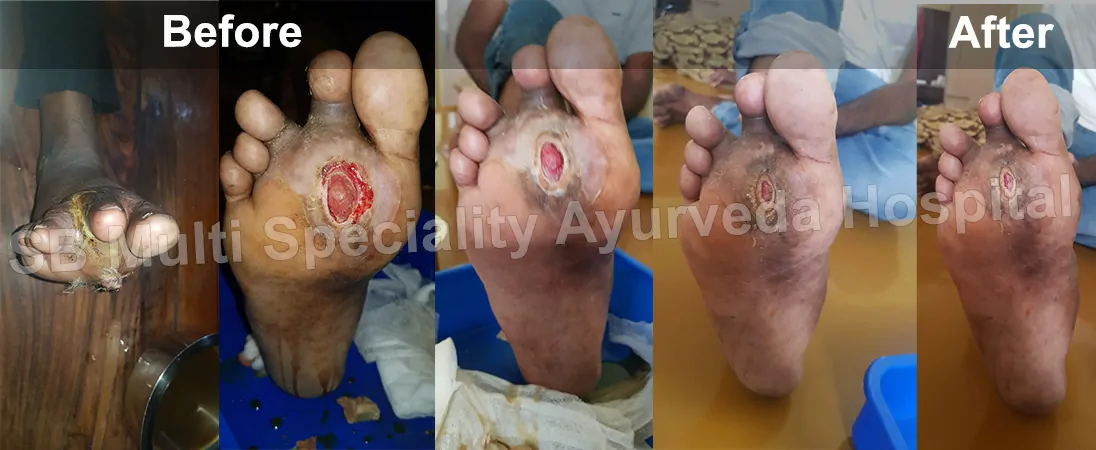
Case 03

Deep round ulcer under the ball of the foot

A punched-out pressure ulcer under the ball of the foot, the classic diabetic foot ulcer.

What happens at each stage

  1. Stage 1. On arrival: discoloured toes and discharge, with the foot too painful and swollen to bear weight.
  2. Stage 2. Cleaning reveals a deep, round crater under the ball of the foot with a red base.
  3. Stage 3. The crater becomes shallower as tissue fills it in from the bottom upwards.
  4. Stage 4. The rim closes in and the surrounding callus softens.
  5. Stage 5. A flat, closed scar remains where the crater was.

Note on this case

An ulcer in this position is caused as much by pressure and loss of sensation as by blood sugar. Offloading the area so the patient stops walking directly on the wound matters as much as the dressing itself, and that is part of the instruction given at discharge.

Individual results vary. This sequence is not a promise of any outcome, and it does not show every patient's experience.
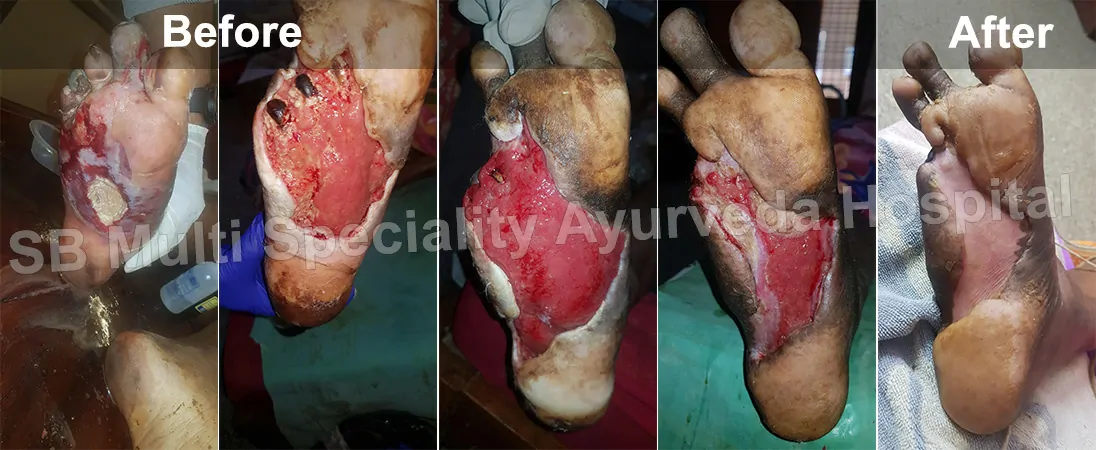
Case 04

Gangrene of the heel

Black, dead tissue over the heel — the presentation that most often ends in amputation.

What happens at each stage

  1. Stage 1. On arrival: a raw, sloughy area over the heel with dead tissue at the margins.
  2. Stage 2. The full extent becomes visible once the black eschar is lifted: a deep heel wound with exposed tissue.
  3. Stage 3. After cleaning, the wound base and the surrounding skin begin to look healthier.
  4. Stage 4. The heel starts to resurface, with the wound flattening and the margins closing.
  5. Stage 5. A healed, contracted scar covers the heel and the foot is preserved.

Note on this case

Heel gangrene is difficult because the skin there is thin and takes weight. Cases like this are the reason the hospital admits patients rather than treating them by appointment alone — the wound is reviewed and dressed daily, and the internal medicine is changed as the blood work changes.

Individual results vary. This sequence is not a promise of any outcome, and it does not show every patient's experience.
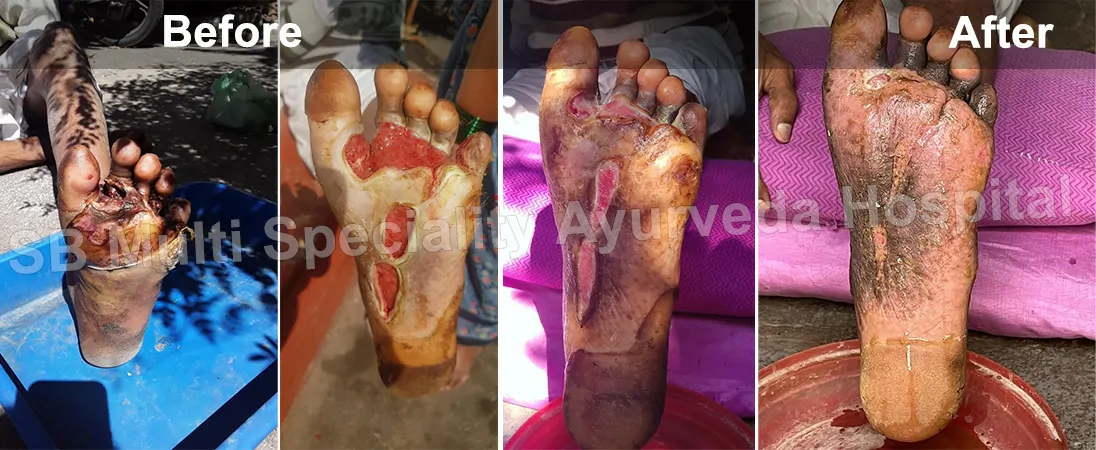
Case 05

Large wound across the sole and mid-foot

Skin loss across most of the sole, with darkened toes at the top of the foot.

What happens at each stage

  1. Stage 1. On arrival: an extensive wound over the sole with dead tissue and discharge.
  2. Stage 2. Wide cleaning is carried out and the whole affected area is opened and washed.
  3. Stage 3. The bed turns deep red across its full width as healthy tissue takes hold.
  4. Stage 4. The margins begin to close from the edges towards the centre.
  5. Stage 5. The sole is covered with new skin and the foot bears weight again.

Note on this case

A wound this size heals slowly and inwards from every edge at once. The photographs are weeks apart. What is not visible here is the blood work behind it — sugar control is what decides whether a bed like this stays red or breaks down again.

Individual results vary. This sequence is not a promise of any outcome, and it does not show every patient's experience.
Case 06

Whole-sole wound with toe involvement

A wound running the length of the sole with dead tissue at the toes and heel.

What happens at each stage

  1. Stage 1. On arrival: the sole is largely open, with blackened tissue at the toes and along the heel.
  2. Stage 2. Dead tissue is removed in stages rather than all at once, protecting what is still alive.
  3. Stage 3. Fresh tissue appears along the length of the wound and the dark areas separate away.
  4. Stage 4. The wound narrows to two strips and the surrounding skin regains its colour.
  5. Stage 5. The sole is covered and the toes are still in place.

Note on this case

Removing dead tissue in stages, rather than in one wide excision, is deliberate: it protects tissue that still has a blood supply and can recover. It takes longer, and it is the reason feet like this one are still intact at the end of the sequence.

Individual results vary. This sequence is not a promise of any outcome, and it does not show every patient's experience.

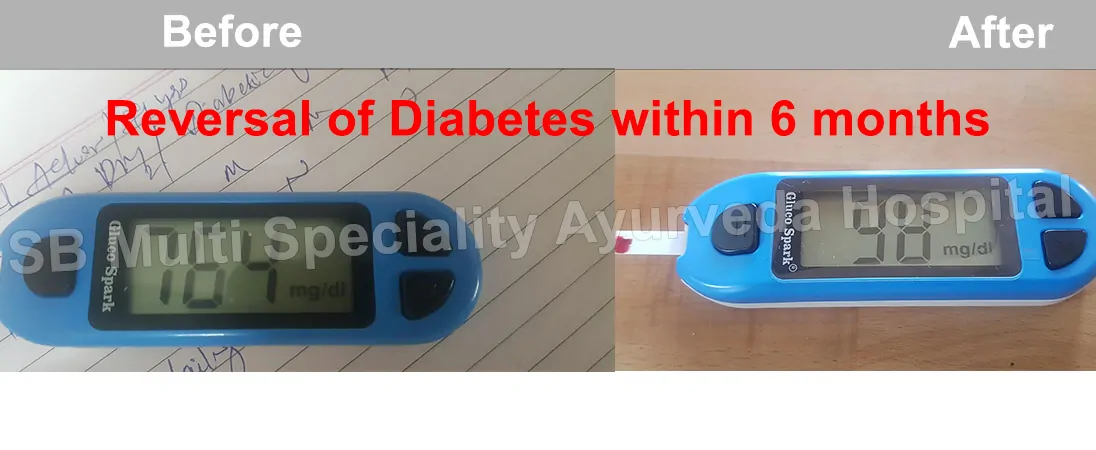
Case 07

Blood sugar readings, before and after

One patient's home glucometer readings at the start of treatment and six months later.

Sequence of clinical photographs labelled Before and After, showing blood sugar readings, before and after at successive stages of treatment.

What happens at each stage

  1. Stage 1. Before: the meter reads 407 mg/dl.
  2. Stage 2. After, six months later: the meter reads 98 mg/dl.

Note on this case

This is a photograph the patient took of their own glucometer, not a laboratory report, and a single reading is only a snapshot of one moment in the day. Readings like these are what the hospital uses alongside HbA1c blood work to decide whether medicine can safely be reduced. The wording printed on the image is the hospital's own; treat any single reading as one data point, not a result you should expect.

Individual results vary. This sequence is not a promise of any outcome, and it does not show every patient's experience.

Wound photographs cannot show what is happening to blood sugar, kidney function or circulation underneath. Those are assessed with blood work at every review, and treatment is adjusted person by person.

Source: our own case records at SB Multispeciality Ayurveda Hospital, published at sbayurvedahospital.com.

THE CHOICE

Two paths from here.

The path you're on now

  • One tablet becomes two. Two become three. Eventually, insulin.
  • Money every month on medicines, for the rest of your life, rising with every dose increase
  • A 10-minute consultation twice a year
  • “Cut down on rice and sugar”
  • Complications get treated once they show up
  • You get told this is progressive and lifelong

You manage a condition that gets more expensive every year.

The supervised remission path

  • Doses reviewed every 1-2 weeks with the goal of going down, not up.
  • A defined program, with a defined length, and an endpoint
  • Weekly contact through the entire tapering phase
  • A protocol built around the food your family actually cooks
  • Kidneys, eyes and nerves tracked before they become a problem
  • You find out, from your own labs, whether it has to be

You work toward needing less of everything.

QUESTIONS

Questions people ask before registering

Free. No card. No obligation.

Nothing to pay, nothing to cancel, and nothing to buy on the call.

Your health information stays private.

We never sell, share or trade your health data.

No spam.

Session reminders and the recording. Unsubscribe any time, in one click.

You've been managing this for years.

Managing is not the same as improving.

In 75 minutes, you'll know which one is still on the table for you.

Find out whether remission is realistic for you.

A free live session with Dr Ajeet Pawar on how type 2 diabetes remission works, who achieves it, and how medication is safely reduced under supervision.

75 minutes · Free · Recording included

Live Q&A is not included in the recording.

100% free · No credit card · We never sell your health data

Patient reviews

What patients say on Google

4.94.9 average across 534 Google reviews at our three hospitals.

These ratings and quotes are published on our Google listings. Follow any link below to read every review, unedited, on Google.

  • Jayanagar, Bengaluru

    4.9224 reviews

    The doctor and staff were very caring and professional.
    Published on Google
    Read all reviews on Google
  • Yadavagiri, Mysuru

    5.0159 reviews

    The staff was friendly, courteous, and attentive to my needs.
    Published on Google
    Read all reviews on Google
  • Amruthnagar, Bengaluru

    4.9151 reviews

    The hospital's facilities are modern, clean, and well-maintained.
    Published on Google
    Read all reviews on Google

Reviews describe individual experiences. They are not a promise of a particular result, and outcomes vary from person to person.

Visit us

Our hospitals

The same clinical team runs all three locations. Call either line for any branch — the numbers are shared.